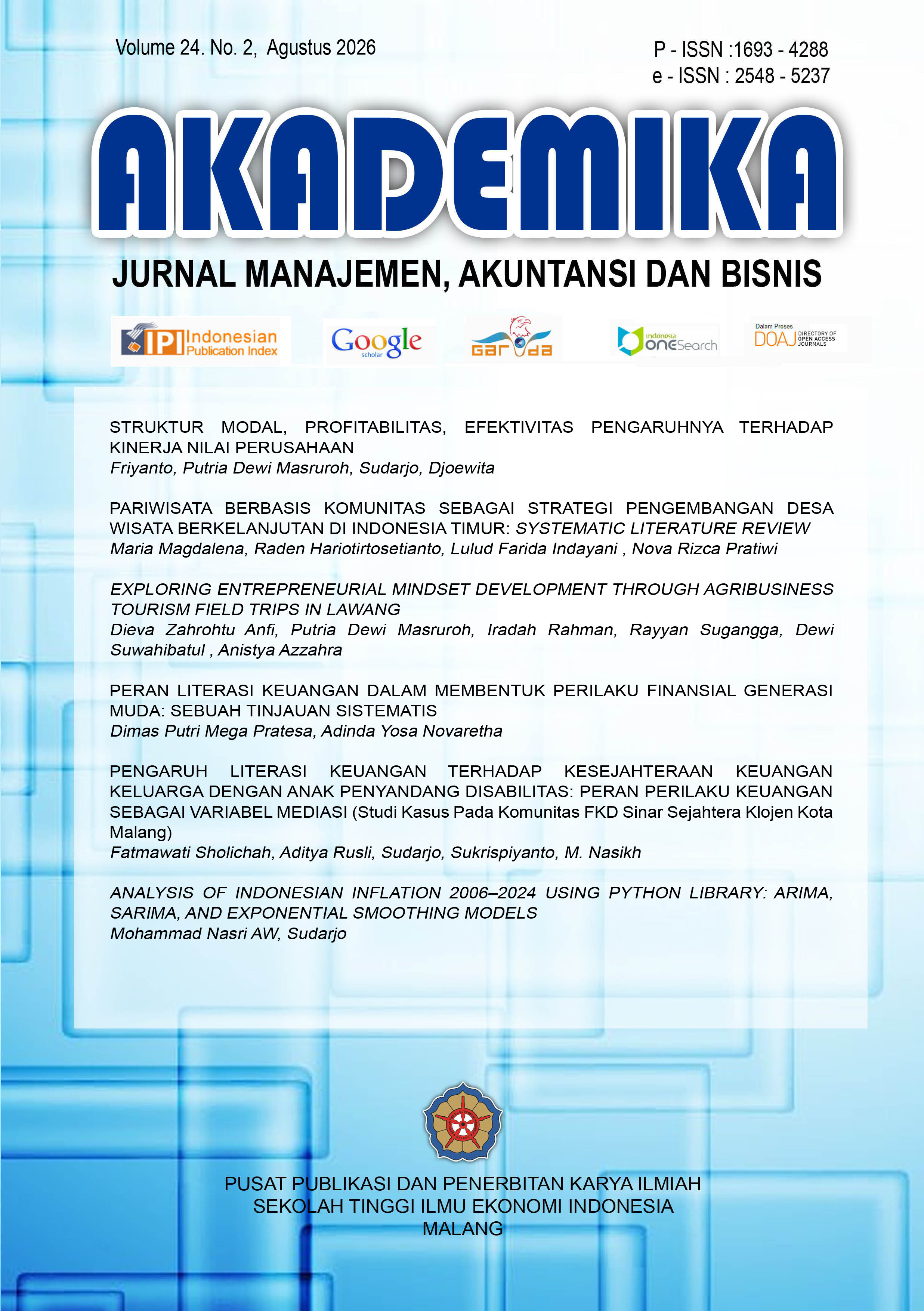
ANALYSIS OF INDONESIAN INFLATION 2006–2024 USING PYTHON LIBRARY: ARIMA, SARIMA, AND EXPONENTIAL SMOOTHING MODELS
DOI:
https://doi.org/10.51881/jak.v24i2.205Keywords:
Inflation, Forecasting, Machine Learning, Time Series; Python, IndonesiaAbstract
This paper conducts an in-depth analysis of Indonesia’s monthly inflation rate from January 2006 to December 2024, employing advanced time series techniques to uncover underlying patterns and to develop a robust predictive framework. Utilizing Python’s TimeSeriesSplit for cross-validation, we implement and compare multiple forecasting models—specifically ARIMA, SARIMA, and Exponential Smoothing—evaluating their performance across a rolling forecast horizon. The study identifies key periods of volatility linked to the 2008 global financial crisis, domestic fuel subsidy reforms, and the COVID-19 pandemic, and assesses the degree to which seasonal and trend components explain inflation behavior. The SARIMA model selection yields SARIMA(5,1,1)(1,0,1,12), with AIC = 241.576. The seasonal MA coefficient is -0.8062 (t-stat = 0,000), indicating significant seasonal persistence. The lower AIC suggests that the seasonal component improves model fit. Our findings indicate that while seasonal patterns are present, they are relatively mild, and that a SARIMA model incorporating both non-seasonal and seasonal elements yields the most accurate out-of-sample forecasts. The paper contributes a methodological template for inflation forecasting in emerging markets and offers policy-relevant insights on the predictability of Indonesian inflation under structural and shock-driven conditions.
Downloads
References
Rifai, N. A. K. (2024). Forecasting Inflation In Indonesia Using The. Autoregressive Integrated Moving Average METHOD https://pdfs.semanticscholar.org/5ed3/0c2303319f0ffaa796fc5d16e22d134ffc9a.pdf
Mahmudah, U. (2024). Robust prediction intervals for indonesian inflation. https://ejournal2.undip.ac.id/index.php/jfma/article/download/20502/11190
Fibriyani, V. (2024). Estimating time series semiparametric regression model using local polynomial estimator for predicting inflation rate in Indonesia. https://www.sciencedirect.com/science/article/pii/S1018364724004610
Indonesia's Fuel Subsidies Reforms. https://documents1.worldbank.org/curated/en/099748505212431959/pdf/IDU1e31e5e531f16114baa1b62c1b3201c9c2e68.pdf
Indonesia: Staff Report for the 2013 Article IV Consultation. https://www.imf.org/external/pubs/ft/scr/2013/cr13362.pdf
Implementing Time Series Cross Validation to Evaluate the Forecasting Model Performance. https://www.researchgate.net/publication/387146892_Implementing_Time_Series_Cross_Validation_to_Evaluate_the_Forecasting_Model_Performance
Vasenska, I. (2025). Comparative Analysis of Machine Learning and Deep Learning Models for Time Series Forecasting. https://www.mdpi.com/2674-1032/4/3/46
Hyndman, R.J., & Athanasopoulos, G. (2021). Forecasting: Principles and Practice (3rd ed.). OTexts: Melbourne, Australia. https://otexts.com/fpp3
Chapter 2: Twenty Years after the Asian Financial Crisis in Indonesia. https://www.elibrary.imf.org/display/book/9781484337141/ch002.xml
Passarella, R. (2025). Comparative Analysis of Machine Learning Models for Predicting Indonesia's GDP Growth. https://library.acadlore.com/ATAIML/2025/4/3/ATAIML_04.03_02.pdf
The Covid-19 Pandemic and Inflation in Indonesia. ttps://www.researchgate.net/publication/359369219_The_Covid-19_Pandemic_and_Inflation_in_Indonesia
Abdulloh, F. F. (2024). Performance Analysis of Machine Learning Algorithms. https://joiv.org/index.php/joiv/article/download/2567/1161
TimeSeriesSplit — scikit-learn 1.7.2 documentation. https://scikit-learn.org/stable/modules/generated/sklearn.model_selection.TimeSeriesSplit.html
An In-Depth Guide to Time Series Cross-Validation and Sliding Forecasts. https://saimaharana.hashnode.dev/an-in-depth-guide-to-time-series-cross-validation-and-sliding-forecasts
Enhanced Inflation Forecasts with Machine Learning in Emerging Markets. https://www.elibrary.imf.org/view/journals/001/2024/206/article-A001-en.xml
Liapis, C. M. (2023). A multivariate ensemble learning method for medium-term forecasting. https://link.springer.com/article/10.1007/s00521-023-08777-6
statsmodels.tsa.arima.model. https://www.statsmodels.org/stable/generated/statsmodels.tsa.arima.model.ARIMA.html
statsmodels.tsa.statespace.sarimax. https://www.statsmodels.org/dev/generated/statsmodels.tsa.statespace.sarimax.SARIMAX.html
statsmodels.tsa.holtwinters.ExponentialSmoothing. https://www.statsmodels.org/dev/generated/statsmodels.tsa.holtwinters.ExponentialSmoothing.htmlamples/notebooks/generated/exponential_smoothing.html
Indonesian Central Bureau of Statistics [2025]. Tingkat Inflasi Harga Konsumen Nasional Bulanan (M-to-M), https://www.bps.go.id/id/statistics-table/1/OTEzIzE=/tingkat-inflasi-harga-konsumen-nasional-bulanan--m-to-m----sup-1--sup---2022-100-.html
Full python code can see in github: https://github.com/nasriaw/Analysis-of-Indonesian-Inflation
Downloads
Published
How to Cite
Issue
Section
License
Copyright (c) 2026 Moehammad Nasri Abdoel Wahid , Sudarjo

This work is licensed under a Creative Commons Attribution-ShareAlike 4.0 International License.
Penulis yang menerbitkan jurnal ini menyetujui persyaratan berikut:
- Hak cipta atas artikel apa pun dipegang oleh penulisnya.
- Penulis memberikan jurnal, hak publikasi pertama dengan karya yang dilisensikan secara bersamaan di bawah Lisensi Atribusi Creative Commons yang memungkinkan orang lain untuk membagikan karya dengan pengakuan atas kepenulisan dan publikasi awal karya tersebut dalam jurnal ini.
- Penulis dapat membuat pengaturan kontrak tambahan yang terpisah untuk distribusi non-eksklusif dari versi jurnal yang diterbitkan dari karya tersebut (misalnya, mempostingnya ke repositori institusional atau menerbitkannya dalam sebuah buku), dengan pengakuan dari publikasi awalnya di jurnal ini.
- Penulis diizinkan dan didorong untuk memposting karya mereka secara online (misalnya, di repositori institusional atau di situs web mereka) sebelum dan selama proses pengiriman, karena hal itu dapat mengarah pada pertukaran yang produktif, serta kutipan yang lebih awal dan lebih besar dari karya yang diterbitkan.
- Artikel dan materi terkait yang diterbitkan didistribusikan di bawah Lisensi Internasional Creative Commons Attribution-ShareAlike 4.0