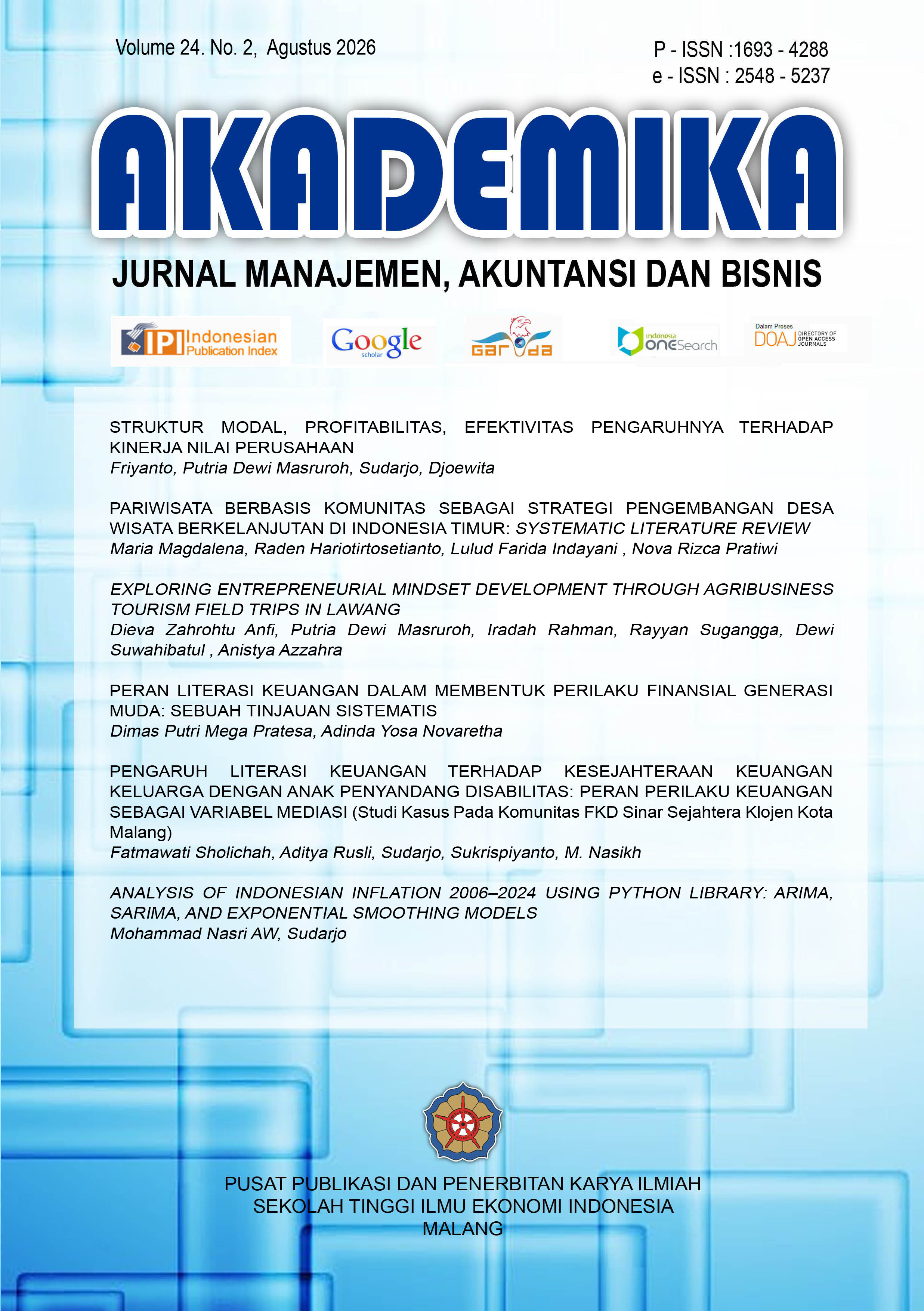
PENGARUH LITERASI KEUANGAN TERHADAP KESEJAHTERAAN KEUANGAN KELUARGA DENGAN ANAK PENYANDANG DISABILITAS: PERAN PERILAKU KEUANGAN SEBAGAI VARIABEL MEDIASI (Studi Kasus Pada Komunitas FKD Sinar Sejahtera Klojen Kota Malang)
(Studi Kasus Pada Komunitas FKD Sinar Sejahtera Klojen Kota Malang)
DOI:
https://doi.org/10.51881/jak.v24i2.209Keywords:
financial literacy, financial behavior, financial well-being, families with children with disabilitiesAbstract
Families with children with disabilities face more complex economic challenges than families in general due to ongoing special needs, such as the costs of therapy, health services, education, and mentoring. This condition requires good financial management skills to achieve family financial well-being. This study aims to analyze the effect of financial literacy on the financial well-being of families with children with disabilities, with financial behavior as a mediating variable. The study applied a quantitative approach through a survey method to 50 parents or guardians of children with disabilities who are members of the Sinar Sejahtera Disability Family Forum (FKD) in Klojen District, Malang City. Data were obtained by questionnaire and analyzed using PLS-SEM (Partial Least Squares Structural Equation Modeling). These findings show that financial literacy has a positive and significant impact on financial behavior (β = 0.984; t = 18.435) and family financial well-being (β = 0.455; t = 2.940). However, financial behavior did not significantly impact family financial well-being (β = 0.130; t = 0.884), thus failing to mediate the relationship between financial literacy and financial well-being. These findings suggest that financial literacy is a key factor contributing to improved financial well-being in families with children with disabilities. This research has implications for developing more targeted financial education and economic empowerment programs to improve the well-being of families with disabilities.
Keywords: financial literacy, financial behavior, financial well-being, families with disabilities, PLS-SEM.
Downloads
References
Consumer Financial Protection Bureau. (2017). Financial well-being in America. Consumer Financial Protection Bureau.
Emerson, E., Hatton, C., Llewellyn, G., Blacker, J., & Graham, H. (2010). Socioeconomic position, household composition, health status and indicators of the well-being of mothers of children with and without intellectual disabilities. Journal of Intellectual Disability Research, 54(12), 1042–1054. https://doi.org/10.1111/j.1365-2788.2010.01378.x
Grohmann, A. (2018). Financial literacy and financial behavior: Evidence from the emerging Asian middle class. Pacific-Basin Finance Journal, 48, 129–143. https://doi.org/10.1016/j.pacfin.2018.01.007
Hair, J. F., Hult, G. T. M., Ringle, C. M., & Sarstedt, M. (2022). A primer on partial least squares structural equation modeling (PLS-SEM) (3rd ed.). Sage Publications.
Lusardi, A., & Mitchell, O. S. (2014). The economic importance of financial literacy: Theory and evidence. Journal of Economic Literature, 52(1), 5–44. https://doi.org/10.1257/jel.52.1.5
Mitra, S., Palmer, M., Kim, H., Mont, D., & Groce, N. (2017). Extra costs of living with a disability: A review and agenda for research. Disability and Health Journal, 10(4), 475–484. https://doi.org/10.1016/j.dhjo.2017.04.007
Parish, S. L., Rose, R. A., Grinstein-Weiss, M., Richman, E. L., & Andrews, M. E. (2018). Material hardship in U.S. families raising children with disabilities. Exceptional Children, 75(1), 71–92.
Potrich, A. C. G., Vieira, K. M., & Mendes-Da-Silva, W. (2016). Development of a financial literacy model for university students. Management Research Review, 39(3), 356–376. https://doi.org/10.1108/MRR-06-2014-0143
Xiao, J. J. (2008). Applying behavior theories to financial behavior. In J. J. Xiao (Ed.), Handbook of consumer finance research (pp. 69–81). Springer.
Downloads
Published
How to Cite
Issue
Section
License
Copyright (c) 2026 Fatmawati Sholichah , Aditya Rusli , Sudarjo, Sukrispiyanto, M. Nasikh

This work is licensed under a Creative Commons Attribution-ShareAlike 4.0 International License.
Penulis yang menerbitkan jurnal ini menyetujui persyaratan berikut:
- Hak cipta atas artikel apa pun dipegang oleh penulisnya.
- Penulis memberikan jurnal, hak publikasi pertama dengan karya yang dilisensikan secara bersamaan di bawah Lisensi Atribusi Creative Commons yang memungkinkan orang lain untuk membagikan karya dengan pengakuan atas kepenulisan dan publikasi awal karya tersebut dalam jurnal ini.
- Penulis dapat membuat pengaturan kontrak tambahan yang terpisah untuk distribusi non-eksklusif dari versi jurnal yang diterbitkan dari karya tersebut (misalnya, mempostingnya ke repositori institusional atau menerbitkannya dalam sebuah buku), dengan pengakuan dari publikasi awalnya di jurnal ini.
- Penulis diizinkan dan didorong untuk memposting karya mereka secara online (misalnya, di repositori institusional atau di situs web mereka) sebelum dan selama proses pengiriman, karena hal itu dapat mengarah pada pertukaran yang produktif, serta kutipan yang lebih awal dan lebih besar dari karya yang diterbitkan.
- Artikel dan materi terkait yang diterbitkan didistribusikan di bawah Lisensi Internasional Creative Commons Attribution-ShareAlike 4.0